
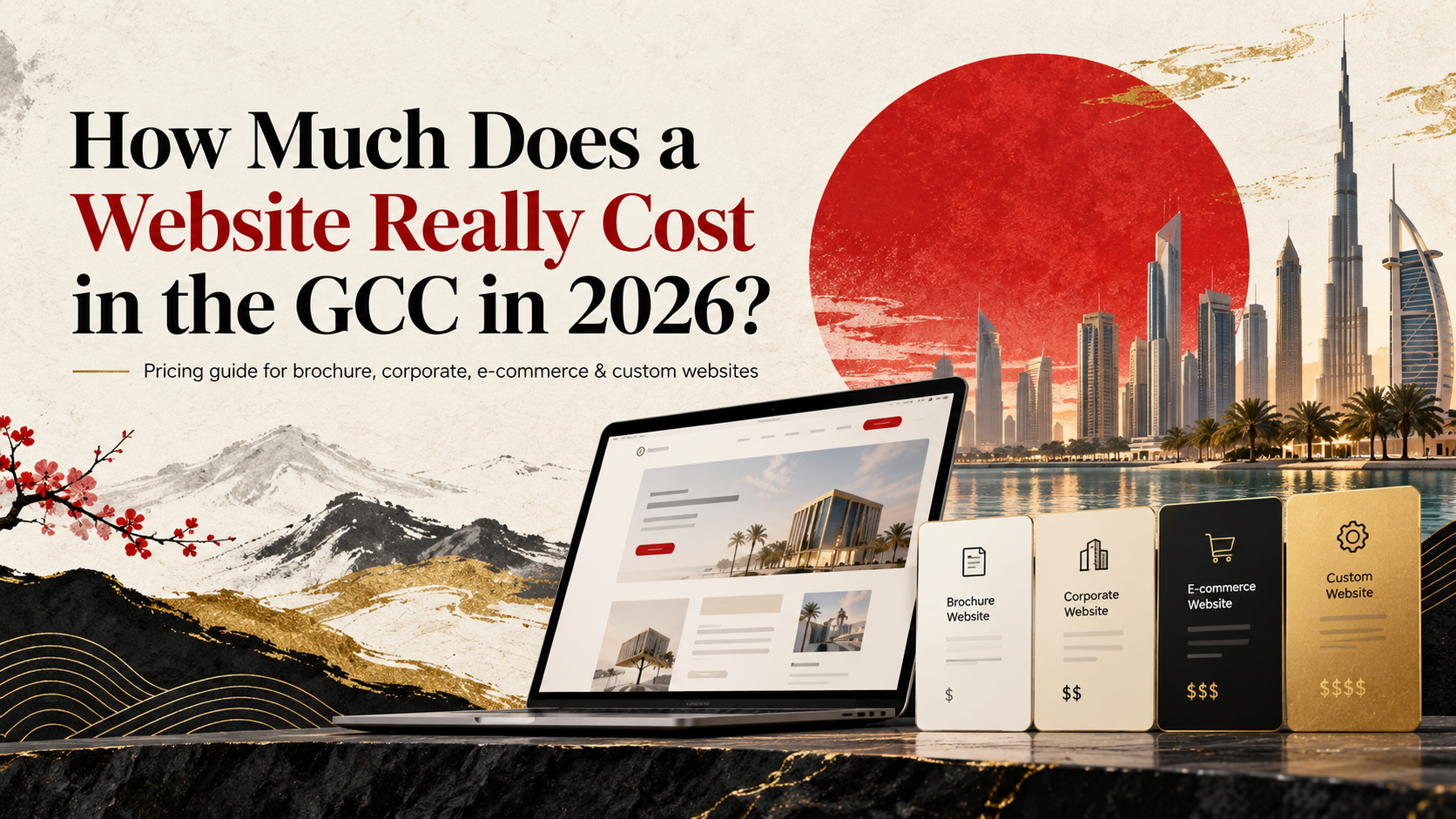
How Much Does a Website Really Cost in the GCC in 2026?
Ask five web agencies in the GCC for a quote and you may receive five completely different numbers.
One company might quote $2,000. Another might quote $20,000 for what appears, at first glance, to be the same website..
That does not automatically mean one is overpriced or the other is suspiciously cheap. In most cases, the difference comes down to what is actually being designed, developed and included in the project.
Published 2026 pricing guides from Saudi Arabia and the UAE show exactly how wide the market is. Saudi guides put ordinary business websites anywhere from a few thousand riyals to tens of thousands, while Dubai pricing data shows similarly large differences between template projects, custom corporate websites, e-commerce stores and bespoke platforms.
So instead of asking:
How much does a website cost?
A better question is:
What type of website does my business actually need?
Typical GCC Website Costs in 2026
The following are useful planning ranges for professional SME and mid-market projects, based on current public Saudi, UAE and GCC pricing. They are not fixed industry tariffs.
| Website type | Typical planning budget |
|---|---|
| Brochure / small business website | $1,000–$5,000 |
| Corporate website | $4,000–$20,000 |
| E-commerce website | $5,000–$30,000 |
| Custom platform / web application | $15,000–$80,000+ |
Large enterprise projects can go significantly beyond these figures, particularly when they include complex integrations, multiple markets, custom workflows, security requirements or large content migrations. Current GCC e-commerce guides alone show ranges extending from relatively simple platform builds to $80,000+ enterprise implementations.
1. Brochure Website: $1,000–$5,000
A brochure website is usually designed for a small business that mainly needs a professional online presence.
It may include:
- Home page
- About page
- Services
- Projects or portfolio
- Contact page
- WhatsApp and enquiry forms
- Basic search optimization
- Mobile-responsive design
At the lower end, expect an existing template or design system with relatively limited customization.
At the higher end, you may receive custom UI design, animations, stronger copy structure, Arabic and English versions, analytics and better performance optimization.
For a restaurant, local service provider, consultancy or newly established company, this can be more than enough.
You do not need to pay for enterprise technology when your website's primary job is to explain what you do and generate enquiries.
2. Corporate Website: $4,000–$20,000
A corporate website is different.
It may have 15, 30 or even 100+ pages, multiple service categories, resources, case studies, locations, recruitment pages and multilingual content.
The cost usually reflects work such as:
- UX planning
- Custom UI design
- Content architecture
- Arabic and English layouts
- CMS development
- Blog or resource center
- Advanced forms
- CRM integrations
- Analytics and tracking
- Technical SEO
- Redirect and migration planning
- Performance optimization
- Quality assurance across devices
Proper bilingual development is also more than translating the words. Arabic requires genuine right-to-left design and additional layout testing.
This is one reason apparently similar corporate websites can have very different budgets.
3. E-commerce Website: $5,000–$30,000
An online store has considerably more moving parts than a normal company website.
A GCC e-commerce project may require:
- Product catalog management
- Variations and inventory
- Arabic and English
- Local currencies
- VAT configuration
- Payment gateways
- Apple Pay
- Mada in Saudi Arabia
- Buy-now-pay-later providers
- Shipping integrations
- Coupons and promotions
- Transactional email
- Analytics
- Product feeds
- Conversion tracking
- ERP or inventory synchronization
A simple Shopify, WooCommerce, Salla or Zid store will naturally cost far less than a completely custom storefront connected to an ERP, multiple warehouses and custom checkout logic.
Published GCC pricing reflects this: starter stores can cost only several thousand dollars, while advanced and enterprise implementations rise into tens of thousands.
4. Custom Website or Web Platform: $15,000–$80,000+
This category is where the word “website” becomes misleading.
You may actually be building software.
Examples include:
- Customer portals
- Booking systems
- SaaS products
- Membership platforms
- Marketplaces
- Dashboards
- Internal business systems
- Complex quotation systems
- Vendor portals
- Custom B2B ordering
- Multi-tenant platforms
Once users have accounts, permissions, dashboards, workflows, subscriptions, documents, notifications or complex integrations, the project should be estimated like a software product rather than a collection of web pages.
What Actually Changes the Price?
Custom design
A professionally designed interface takes longer than installing a theme and changing the logo.
That does not mean templates are bad. A template can be the correct choice when budget and launch speed matter more than differentiation.
Arabic and multilingual development
Arabic should affect layout, typography, navigation, components and testing — not only text translation.
A multilingual project therefore requires additional design, development and QA.
Content
Does the agency receive finished text and images?
Or are they responsible for research, copywriting, photography, illustrations and localization?
The difference can be substantial.
Integrations
Connecting a form to an email inbox is simple.
Connecting your website to Salesforce, HubSpot, an ERP, payment gateway, inventory platform, booking engine or internal API is a different project.
SEO
There is also an important difference between:
We installed an SEO plugin.
and:
“We designed the website's architecture, metadata, internal linking, redirects, structured content and technical foundations around organic search.”
Performance
Optimization takes engineering time.
Image handling, caching, CDN configuration, fonts, JavaScript, third-party scripts and server performance all affect the final result.
Do Not Compare Quotes by Price Alone

When comparing proposals, compare what each company is actually delivering.
Ask:
- Is the design custom or template-based?
- Is Arabic included?
- Who supplies the content?
- How many unique page templates are being designed?
- Is mobile design included?
- Is technical SEO included?
- Are analytics configured?
- Are redirects handled?
- Are integrations included?
- What happens after launch?
- Who owns the website and source code?
- What recurring costs will remain?
The cheapest proposal can become expensive if everything important becomes an extra.
The most expensive proposal can also be unnecessary if your business simply does not need that level of engineering.
What Should You Budget?
For most businesses, the right budget is not the maximum amount you can spend.
It is the amount required to build a website capable of doing its job properly.
If your goal is credibility and enquiries, a focused corporate website may be enough.
If your revenue depends on online transactions, conversion optimization and e-commerce infrastructure deserve a larger share of the budget.
If the website operates part of your business, treat it like software.
Final Thought
A website should not be priced by the number of pages alone.
You are paying for some combination of strategy, design, development, content, integrations, performance, search visibility and long-term maintainability.
Define those requirements first.
Then the price starts to make sense.